
Overview
Medium: Poem (Lay/Lai, based on extant example)
Written: October 2025
Inspiration: Based upon The Lay of the Honeysuckle, by Marie de France (12th century)
First Performed: Midrealm Crown Tourney, Fall 2025 (October 18, 2025)
The Tale of the Anglo-Norman

It pleases me, I’m willing too
To tell a story plain and true
Louis LeCoffrier is his name
Who from the third crusade he came
A noble Knight Hospitaller
Takes to the list to prove his worth.
A second time, the crown he seeks
With skillful and precise techniques.

Much to say of him there be:
His feats of battle strategy
A wartime leader of command
And negotiator of demands.
A man not only strong of blade
Most skillful in the things he’s made
For chains and coronets of gold
Draw the eyes of all who behold.

He sets off now unto the ring
To return as our dragon king!
Notes
This poem was written for the Crown Tourney Praise Poetry Project in the fall of 2025. It was written for the combatant Earl Louis LeCoffrier.
Louis was ultimately victorious in the crown tournament.
The syllables and rhyme scheme of the poetic translation was followed, rhyming couplets with primarily octosyllabic (eight-syllable) lines. The single couplet pair at the end was my own addition, to dramatically close out the poem on their approach. Liberties were taken with the length of stanzas, as the original poem was rather lengthy and not divided up into manageable stanza sizes.
Research & Resources
The Lay of the Honeysuckle also known as Chevrefoil, is is the eleventh poem in the collection called The Lais of Marie de France. A Lay (or Lai, in French) was a form of French poetry in which a short tale, normally connected to Arthurian legend, was told in the form of primarily octosyllabic verse.
This particular poem tells the tale of the chivalric romance of Tristan and Iseult (Isolde), and uses the honeysuckle (chevrefoil) as s symbol of love.
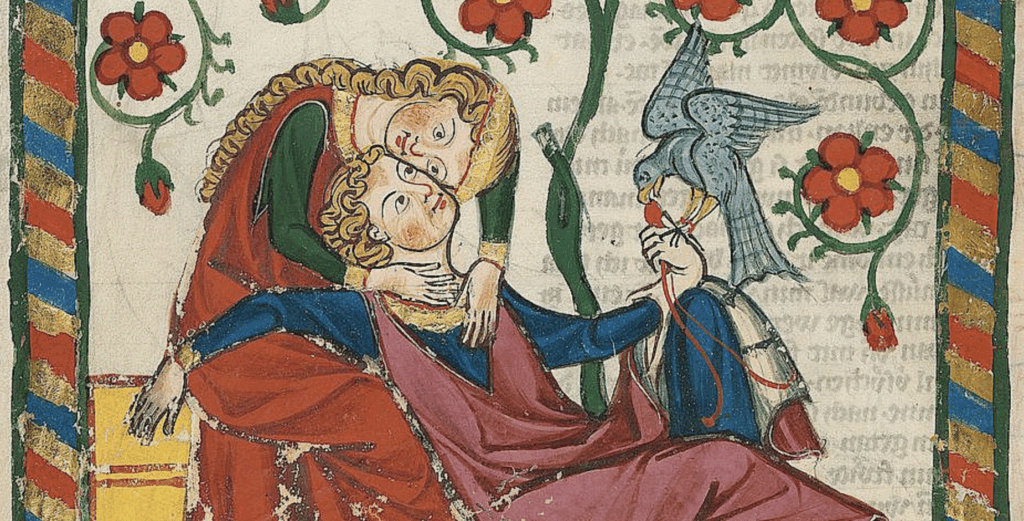
I have not included the full text of the original poem in this post as it is quite lengthy. A direct translation of the original text may be found HERE.
The poetic translation of the poem, which was used to inspire my poem, is found HERE.
Image and information on poem’s history was taken from Storytelling DB. Link to article HERE.
 Angist Arts