
Overview
Medium: Poem (Form Unknown, based on extant example)
Written: May 2024
Inspiration: Based upon 10th century Old English poem “The Husband’s Message”
First Performed: Midrealm Crown Tourney, May 2024 (May 25, 2024)
I wish to wind a tale
told to this throng,
Of our kindred once king,
the warrior Earl Wigthegn.

Question does not come
Of aptitude in arms,
Clad in chain of gold
And castled coronet.

But dare not doubt
His sincerity of spirit,
With kindness and care
As strong as sword.

For all who walk in wake
Of the Earl
Shall feel his support
With every step.

He approaches now
Having bid farewell
to crown most fair.
For does grim dragon
Curse all kings
With but reign of
Half one year.

But not slowed is
The journey subsequent.
For no living man
Can corral the course
Of his lady’s
Mirth and mischief
For not yet one
March of the moon
Has crossed since crown
Was carried off.

Yet merrily the man
Covets to consort
His noble lady love,
As she takes on tournament
Most sacred and sovereign.

There is no want
Or desire in him,
For he does not wish
For gold or glory,
Not horses nor heroics,
Nor the mirth of mead.

Not any of them
Across the earth,
The true Earl’s treasures.

The Earl’s treasure is safekept
In ancient sacred vow.
Held is her right hand
As they present
Before populace and crown

Well that he wishes,
To carry this compact,
To protect this promise,
While he still walks,
That these two often
Speak of softly
When day is done.
Notes
This poem was written for the Crown Tourney Praise Poetry Project in the spring of 2024. It was written for Earl Wigthegn, consort of his wife Countess Neassa O’Cathasaigh.
I knew a decent amount about Wigthegn from his recent reign, but I spoke with Neassa and members of their formal royal retinue (having just stepped down as King and Queen less than a month prior) on details and any particular things that would be good to highlight. Having been a sovereign who was now going in as consort, I decided to touch upon his qualities beyond those of martial prowess. Inspiration was also taken from the extant Anglo-Saxon poem I based this piece upon, touching on the love and support he holds for his candidate, both as her consort and as her husband.
Research & Resources
This poem is based upon the 10th century Old English poem “The Husband’s Message”, which tells tale of a man who was forced to leave his homeland and wife due to a feud, and sends her a message carved on a plank of wood, professing that his love for her remains and implores she come and find him in his new home so that they may reunite.
The original old english and the modern english translation I used are below, but both have areas missing as the manuscript in which it was recorded (the Exeter Book) had suffered burn damage. Several translations of this poem exist, though many of them are rather interpretive of the language. The one I based mine off of was the most direct translation of the original language I was able to locate.
Original Poem
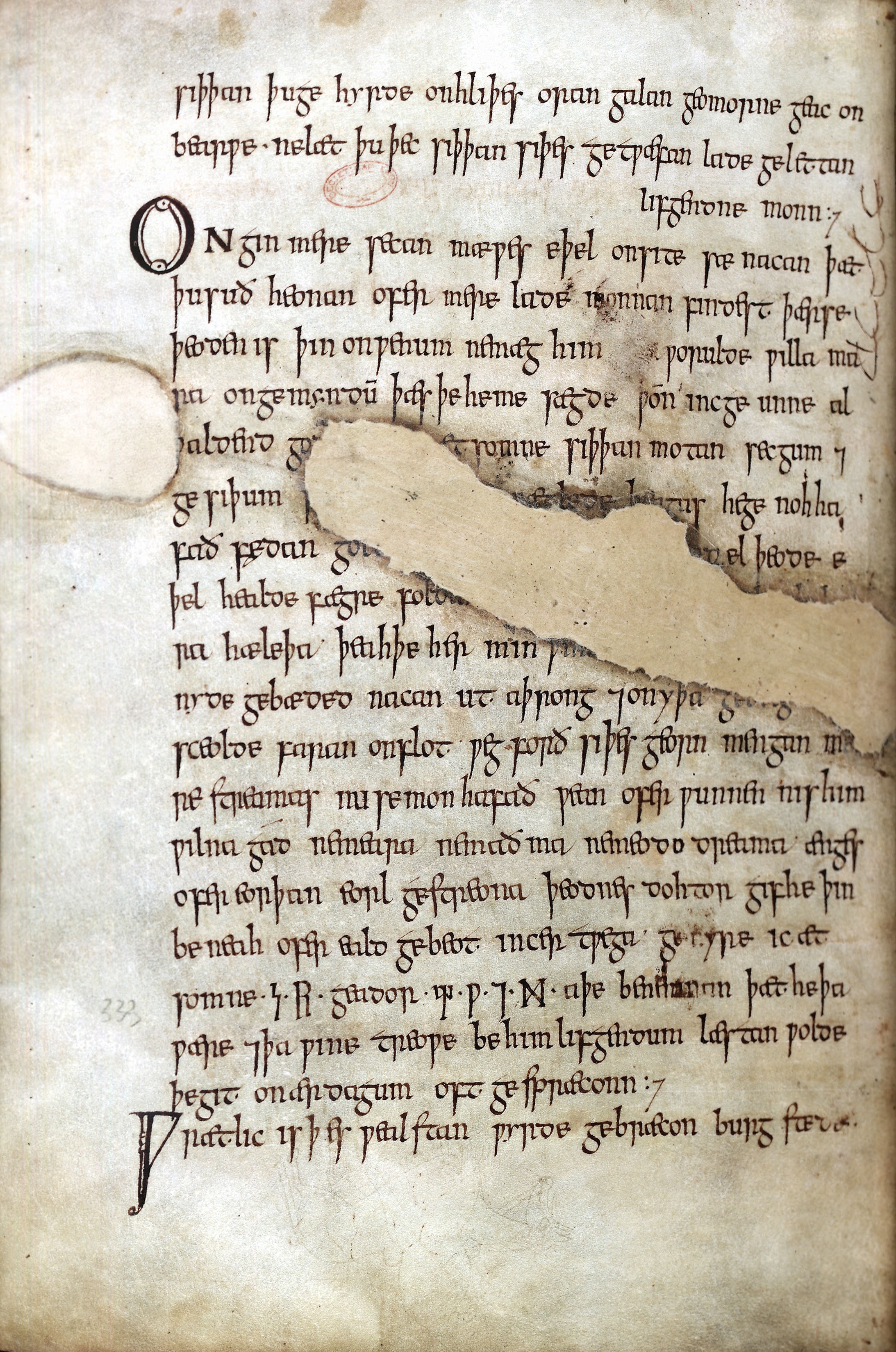
Original Anglo-Saxon
Nū iċ onsundran þē secgan wille
[......] trēocyn iċ tūdre āwēox
in mec æld[a .........] sceal
ellor londes setta[n........]c
sealte strēamas [.......]sse.
Ful oft iċ on bātes [..........] ġesōhte,
þǣr mec mondryhten mīn [onsende
o]fer hēah hafu; eom nū hēr cumen
on ċēolþele, ond nū cunnan scealt
hū þū ymb mōdlufun mīnes frēan
on hyġe hycge. Iċ ġehātan dear
þæt þū þǣr tīrfæste trēowe findest.
Hwæt, þec þonne biddan hēt se þisne bēam āgrōf
þæt þū sinchroden sylf ġemunde
on ġewitlocan wordbēotunga
þe ġit on ǣrdagum oft ġesprǣcon,
þenden ġit mōston on meoduburgum
eard weardiġan, ān lond būgan,
frēondscype fremman. Hine fǣhþo ādrāf
of siġeþēode; heht nū sylfa þē
lustum lǣran þæt þū lagu drēfde
siþþan þū ġehȳrde on hliþes ōran
galan ġeōmorne ġēac on bearwe.
Ne lǣt þū þec siþþan sīþes ġetwǣfan,
lāde ġelettan lifġendne monn.
Onġin mere sēċan, mǣwes ēþel,
onsite sǣnacan þæt þū sūð heonan
ofer merelāde monnan findest
þǣr se þēoden is þīn on wēnum.
Ne mæġ him worulde willa ġelimpan
māra on ġemyndum, þæs þe hē mē sæġde,
þonne inc ġeunne alwaldend God
[þæt ġit] ætsomne siþþan mōtan
secgum ond ġesīþum s[inc brytnian]
næġlede bēagas. Hē ġenōh hafað
fǣttan goldes, [feohġestrēona
þæt hē mi]d elþēode ēþel healde,
fæġre foldan [..........
....]ra hæleþa, þēah þe hēr mīn wine
[....................]
nȳde ġebǣded, nacan ūt āþrong
ond on ȳþa ġelagu [āna] sceolde
faran on flotweġ, forðsīþes ġeorn,
menġan merestrēamas. Nū se mon hafað
wēan oferwunnen; nis him wilna gād,
ne mēara ne māðma ne meododrēama,
ǣnġes ofer eorþan eorlġestrēona,
þēodnes dohtor, ġif hē þīn beneah.
Ofer eald ġebēot incer twēġa
ġehȳre iċ ætsomne .ᛋ.ᚱ. ġeador
.ᛠ.ᚹ., ond .ᛗ. āþe benemnan
þæt hē þā wǣre ond þā winetrēowe
be him lifġendum lǣstan wolde
þe ġit on ǣrdagum oft ġesprǣconn.
Translation 1
*Translation by Dr. Ophelia Eryn Hostetter of Rutgers University*
Note: This translation was the most accurate I could find in terms of direct translation of the original text (including the missing burned sections), and is what I used as a basis for my poem. An additional translation is below, but I believe it is much more interpretive of the words in order to fit the poetic form.
Now I wish to tell
apart from you—
the kindred of trees
I wake from seeds
within me….

… I must set down
in another land…
the salt streams…

Quite often
in a boat I
sought the spine,
the homes of heroes
where my manly lord
sends me…
across lofty halls—

I am now come here
on the ship’s deck,
and now you ought
to know how
you ponder
in your mind
the pithy love
of my master.

I dare a command—
to locate there
a tree glory-fast—

What he bids you
request then,
he who cut this wood
so that you would
remember yourself
his promises
treasure-laden

in your wit’s enclosure,
that you two
often spoke of
in days of old,

until you two
were allowed
in the mead-towns
to keep homestead,
to inhabit a single land,
to make love
to each other.

Vendetta drove him
from his triumphant tribe
now he orders you
yourself
be instructed gladly,
to trouble the waters—

afterwards you heard
upon the coastal cliffs
the mournful cuckoo
singing in the boughs.

Do not allow
yourself to end
this journey afterwards—
no living man can
hinder your course.
Seek already the sea,
the homestead of gulls—
be seated in a seaward
ship, so that you may find
your husband—
to the south from here
across the way of waters,
where your lord dwells
in your hopes and dreams.

Nor can worldly desire suit him
more in his mind, of this he said to me,
when All-Wielding
God should grant us two…
together afterwards
we are allowed to
before men and friends…

nailed rings—he holds enough
decorous gold…
strangers hold homewards
the fair earth….

… heroes, though here my friends…

impelled by need
rushing out on a ship
youthful upon the waves
must go forth
upon the ship-ways,
eager for the trip
must blend sea-currents.

Now the man
has subdued
his woes—

there is no want
of desire in him,
not horses nor treasures,
nor the joys of mead

any of them
across the earth,
an earl’s treasures,

prince’s daughter
if he possesses
both of you
over his ancient vow.

Together I should choose
S and R as one, EA, W and D,
declaring my oath,

so that he wishes
to serve this compact,
this conjugal pact,
while he still lives,
that you two often
spoke about
in days gone by.
Translation 2
*Translation by Kevin Crossley-Holland*
Note: This translation makes the actual story told in the poem much clearer, including the clarity that this poem is not the message itself, but being told be plank on which this message was carved. However, I believe it is much more interpretive of the original text in order to a narrative poetic form, including filling in the burned sections with their likely contents.
Now that we’re alone I can explain
The secret meaning of this stave. I was once a child.
But now one of the sons of men, living far from here,
Sends me on errands over the salt-streams,
Commands me to carry a cunningly-carved letter.
At my master’s command I have often crossed the sea,
Sailed in the ship’s hold to strange destinations.
And this time I have come especially
To sow assurance in your mind
About my lord’s great love for you.
I swear that you will find in him
Great faith to you, great loyalty.
O lady adorned with such lovely ornaments,
He who carved the words in this wood
Bids me ask you to remember
The oaths you swore so long ago together;
In those distant days you lived in the same country,
Lived in love together,
Sharing one estate in the beautiful city.
Then a feud, a cruel vendetta, forced him to leave
This land of happy people; I was told to tell you,
Joyfully, that you should undertake a journey
Just as soon as you hear the cuckoo’s sad song,
That mournful sound in the mountain woods.
After that, let no man delay you
Or stop you from sailing over the waves.
Go down to the sea, the home of the gull;
Sail south from here over the salt-streams
To the land where land waits in high expectations.
He nurses no greater wish in the world
(With his own words he told me),
Than that both of you together, by the grace of God,
May give rings once again to men in the mead-hall;
Bestow gifts as before on companions
And warriors. He has won
Wealth enough, though he lives
Far away amongst a foreign people
In a beautiful land.
Forced by the feud to launch his boat from here,
He went over the waves alone in his youth,
Set forth on the way of the flood, eager to
Depart and divide the quiet waters. Now at last your lord
Leaves his sorrows behind him. He will lack nothing,
Neither horses, nor treasure, nor joy in the mead-hall,
O daughter of the prince,
He will want nothing else in the world
If only he may have you for his own,
Fulfilling the former vow between you.
I hear the runes S. and R.,
EA., W. and M. join in an oath
That he will wait for you in that country,
And will always love you for as long as he lives,
Faithful and true to your vows to each other,
The oaths you swore so long ago together
 Angist Arts